Of Financial Inclusion, Hindi Imposition, Gandhiism and InOrganic Growth

You've read the ATM story, haven't you? If you go into an ATM in Hubli, Karnataka and if you were among those crores of Indians that don't know Hindi, you are highly likely to be surprised by this ATM's user interface being in Hindi and English alone. Yes, there could be more ATMs in Karnataka that provide instructions in Hindi than ones that provide instructions in Kannada. This is a glaring trait of our bank markets that one can notice across the country - banks are yet another channel through which Hindi is imposed upon a large non-Hindi geography of India. 

At a time when India is reported to be suffering from poor financial inclusion across the country, the RBI - the central bank that governs all other banks operating in the country, and chartered to increase financial inclusion, sets such standards to these banks with regards to customer services and customer interaction that the banks are all but bullied to perceive better returns in displaying allegiance to the RBI than vowing to serve their customers' original, uncorrupted needs; those needs that require banks to offer services in a language the customer is most comfortable with. 

A brief look at some of the circulars issued by RBI to all types of banks in India will tell us what kind of strikingly lopsided a language plan has gone into the making of its language policies. These policies openly declare Hindi alone as the sacrosanct language that banks must accept in undeterred fashion and impede no processes involved in serving customers using Hindi whereas a similar treatment is not even dealt with for 21 other languages listed as Scheduled languages in the Constitution of India. 

The very act of making one language mandatory as opposed to making 21 other scheduled languages optional in a diverse market such as ours shows how market agnostic these RBI's regulations are and exposes the undesirable government control over a supposed market transaction. The people of India cannot afford to rest so much control in a banker of banks that remains market agnostic but never fails to uphold aspirations of a central government to promote Hindi in the market.

In fact, it appears from the powers entrusted in RBI, it could well be using it to dole out market benefits to banks as an incentive to promote Hindi usage and service among customers and employees respectively. Being instructed to adopt Hindi enablement as one of its top goals, the RBI finds success in this incentive route. A statement issued by RBI's former governor (Mr Subbarao) backing Hindi usage as vital to increasing financial inclusion in India sent a shocker to anyone who understands a customer's actual needs. This is an unfortunate development happening in an intersection of governance and market. 

While imposing Hindi through banks is evidently making financial inclusion a more elusive mirage, RBI has also been making many other things difficult for non-Hindi speaking Indians. The encouragement (and incentives ?) provided to nationalised banks to celebrate Hindi Day, Week and now Fortnight has in a way solemnized this unnecessary and expensive government intrusion into market territory. This has also added on most of India a huge annual tax burden camouflaged under the notion of a mythical financial inclusion, and an even more mythical national interest. In the wake of such Hindi imposing programs inserted by the government into the market, national interest could well be getting compromised, what with the interests of customers being thrown into air. Mahatma Gandhi once said that protection of customer interest should be the top undertaking of any business if it wishes to survive in a market.

In the wake of these anti developments it would be in the best interest of customers, and Indian citizens in general, that the Govt of India ceases to interfere in the operation of banks to this degree where it has to tell them what language must be used and what languages may be used. In a broader sense, the central government must also realize and honor the linguistic diversity in India and stay away from politics of raising the promotion of one Indian language above that of all other Indian languages. 

GOI must immediately make appropriate amendments in the Constitution to accord and reflect equality to all languages of this country. To start with, it should first make all languages listed in Schedule-8 as official languages of the Indian Union and the central government. 

Hindi imposition is an evil remnant of the imperial touch India experienced during the British era. It is in the best of national interest to shed this diseased skin and let Indian growth happen in its own way - organic or inorganic way.

Of War and Peace: Hypocrisy or Democracy?

AT 30 seconds past 9 minutes into this video, while Mr Obama acknowledges being a "direct consequence of Dr King's work" and walking on the steps of Mr King who had said "violence never brings permanent peace; it solves no social problem, it merely creates new ones" while accepting his Nobel Peace Prize, he goes on to say that he cannot sit quiet after being head of State, thereby supporting his warring (violent) route to install peace and his mantra that "war is sometimes necessary."

While this mantra may be true in its own essence, when it comes out of a powerful state such as the USA it exposes how poor its diplomatic abilities are and how weakened its peace-making abilities have become after the days of King and Gandhi, and especially so after existing nearly three centuries as a constitutional democracy.

By accepting that "war.. at some level is an expression of human folly" is Mr Obama hinting that some wars, especially those participated by the USA and other NATO allies are not consequences of human folly? Who is to decide - the NATO forces or Syrian civilians in this case? Will attacking Syria by air be so precisely selective so as to not inflict pain on any civilian and only impact the Syrian armed forces? Even if that precision was achieved does this set the right precedent to future attempts at correcting international wrongs and who needs to correct such wrongs? How is democracy being upheld in a nation (such as Syria that elects its own leaders) when its internal wrongs get corrected by external, unrelated, international and brutal pressures?

Time to stop this hypocrisy and talk about democracy as something that settles organically in the minds of people and as a bottoms-up process based on internal demand and the love for absolute self-rule.

The Legal Fortress around Hindi Imposition

Hindi and English are the lone official languages of the government of Republic India. This means ever since India became a sovereign democratic republic, promising to protect the interests of all its citizens, millions of people of non-Hindi background have been rendered as second grade citizens since their government does not deal in their language(s). This is Hindi Imposition in India summarized in a few lines.

With this kind of bias Government of India (GoI) has shown and even institutionalized towards Hindi language and (thereby) people who speak Hindi, and with the protection this institution has provided to Hindi speakers, it appears that Hindi speaking people are double insulated from adverse forces - being governed by a State government and pampered by the GoI both of which designed to favor Hindi people's rights - while non-Hindi people are left bare and helpless out there, exposed to adverse forces. In various circumstances, this is not a metaphor, but very close to reality indeed.

On the other hand, owing to the lack of protection by this institution, people living in non-Hindi States experience insecurity in their own country, with employment, food provision, primary health and even identity services catered to by the GoI being carried on a channel that only speaks Hindi apart from English. These services are freely assimilated by Hindi speaking people whereas they are indigestible to non-Hindi people of India. Be it in terms of getting their fundamental rights protected or even as far until protecting one's own lineage and having a non-decading population over time, lives of non-Hindi peoples of India are subject to substantial stress thanks to policies framed on unfair interpretations of our constitution, such as seen in The Official Language Act 1963.

Simple, yet tough, majority:
Interestingly, Article 368 of Constitution of India (CoI) rests the power to amend the statute in the hands of the parliament alone, whereas some specific parts of the constitution, including the lists in Schedule 7 and Article 368, cannot be amended without approval from a simple majority of State Legislatures. In the wake of an increased number of States being carved out, passing valid amendments to such sections of the CoI becomes a touch exercise to orchestrate - perhaps an outcome favorable to the central government that would like to retain more power with itself. As though in support of such intentions, Article 3 of the same constitution empowers the central govt to do just that - impede the process of State level opinion formation by fragmenting them. Talk about denial of fundamental rights, huh?

A pragmatic, solution oriented approach to the Hindi Imposition problem will call for amendments to Schedule 7 (the Union, State and the Concurrent lists) and some to the Official Language policy, which incidentally have been in demand since long time across the country. The center though has been successful in evading them or putting them off by means of various available interpretations of the constitution, and its protective and tricky fortress of articles that make it very difficult to achieve these essential amendments that will incorporate real federal features into our democracy.

In the backdrop of this sustained Hindi Imposition in India, it is important to see these pieces of law as blocking vital amendments required to stop this unfair imposition and to make way for equality among people of all Indian languages.

(Related read: Let this September open our eyes!)

Telangana and Tungabhadra: A Call for Democratic Uprising

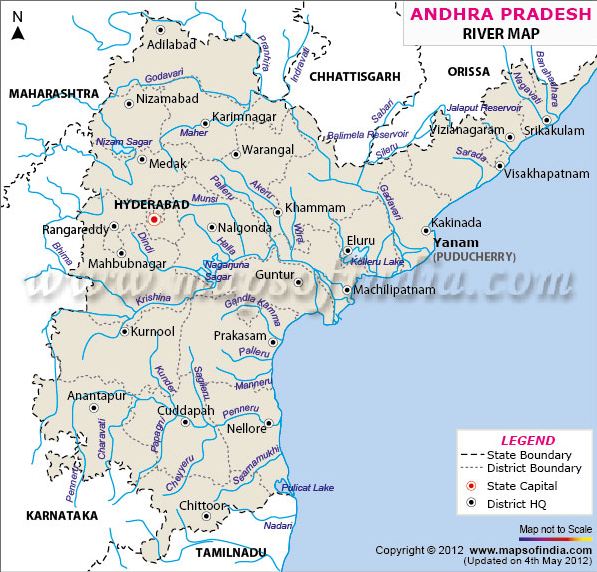
Across the world, boundaries that decide the shapes of Districts or States or even Countries are usually drawn along lines of people's languages, lines of impenetrable geographical structures like mountains and lines drawn by river courses. An exception we see is in India where these widely accepted natural ways of creating boundaries for States are superseded by various actions of the Central Govt - actions that mostly help to remain victorious in elections and to continue centralizing power in Delhi.

While the first of these two intentions seems obvious enough - to retain power, not evil in itself, the second one dealing with increased centralization of power at the Center, stripping the constituent States of those very powers is certainly evil and goes against the spirit of Federalism and the spirit of Democracy. With this kind of superseding taking place in India it is hard for anyone to imagine that the States are indeed federal units in the union that is called India.

One particular comment heard about nations come to my mind in this context - The United States of America is a destructible union of indestructible States, whereas India is an indestructible union of destructible States. But I feel it is immaterial whether a union or a State is destructible or not as long as the responsibility of division and or creating a union rests in the hands of people living in it. But today there is so much confusion, especially in the minds of Telugu speaking people living in Andhra, that a decision either way is going to be a surprise to all of them! Welcoming in the case of some people and unwelcome in the case of others. But when a decision is taken by the people indeed, there is no possibility of surprises and there is no scope for friction to arise out of such decisions.


(source: mapsofindia.com)
Coming to State borders: In the case of the border near Raichur dividing land into Karnataka and Andhra, two rivers decide the contours of this border - the Tungabhadra and the Krishna. While the Krishna river decides the border towards the north of Raichur district, Tungabhadra decides its southern counterpart. The confluence of these two rivers happens inside Andhra at the Srisailam reservoir, within proposed Telangana. With the creation of Telangana State, remaining portion of current Andhra State will be stripped of its control over the Srisailam reservoir and thereby its vast water reserves and irrigation utility. Going by the mood among Telugus during this State reorganization, the new Andhra State may have to beg Telangana for waters that it once enjoyed by being part of the bigger Andhra State, but also faces the risk of Andhra eventually damming the Tungabhadra river flowing within its boundary before draining into Srisailam reservoir. Of course, in this eventuality, the real suffering is experienced by the river and its constituent life forms that are essential for the health of the river itself. At the same time, the Karnataka State runs the risk of a new dam downstream on the Tungabhadra which could lead to significant changes in the ecology of southern parts of Raichur district along the Tungabhadra. This story finds itself repeating with neighboring districts in Maharashtra in the case of Godavari river, which too, enters Andhra through Telangana before passing through Godavari districts in rest of Andhra.

Going back to State reorganization and the politics around it, it is sad to see such wide and deep impacts the politics of State formation could have. This needs to be opposed constitutionally, and the extreme powers of the Center (accorded by Art 3 of the Indian Constitution) to re-draw State borders and thereby gain higher control over States' administrative affairs needs to be questioned, toned down and powers returned to the State governments, which in turn have to do the due diligence of real public consultations before taking such important decisions.

Times, They're a Stoopin'!

The Times of India allowed this article to feature in its daily on July 24, 2013. A one line summary of this article would be this:
It's preposterous, in this context, to say that everyone living in Bangalore is expected to know Kannada. This is one more example of not much thought going into the production of schoolbooks.
The context being alluded to here is the appearance of some Kannada poems printed in Roman script in textbooks of classes 1 and 2. Oh! What a shocker, isn't it? What is? That the author, while talking about textbooks, makes a big mistake in relating the school going children that are taught Kannada to all the people living in Bangalore!

(Source: TOI)
While it is preposterous by itself for a national daily to be carrying such a lopsided report that sarcastically ridicules the State's education system and its appointed bodies, it is sad that it is based on the author's poor understanding of the teaching ecosystem within a school, or even within a city. The author summarily ignores, not even discounts, the vital role of teacher-to-teacher interaction at the school level, and in some cases even at the school district level. For anyone accustomed to the project-work style of teaching in many contemporary schools this should appear like another interesting project for kids to come back with their comprehension of the poems; the author conveniently sidelines all such creativity that a good teacher will anyway possess.

As if it were a given, the author assumes that English teachers in these schools do not know Kannada, neither that they communicate or even share rooms with teachers who know Kannada. How dangerous an assumption, if it were true, this is that it hints at the poorest state of affairs in schools that some of our own children are being educated in. It shows what kind of isolated dins we're sending our children into everyday, where teachers do not talk to one another, do not share lessons they learnt, nor do the schools communicate among themselves, do not evolve the best methods of teaching out of such basic collaborative means. What kind of future citizens (of this city?) are we making out of our children by indirectly providing such isolated wells as schools where one is supposed to learn the fundamental lessons for one's life?

If such assumptions of this author are indeed true, there need not be any doubt that these schools are designed to drive our children down the rotten lane of life. If untrue, I wonder what a national daily like TOI is doing by printing such articles time and again!?